
The slip-on shoe dominating modern street style isn’t just a fashion statement; it’s a structural tool for whole-body alignment. If you spend long hours on your feet, you already know the draining ache of chronic arch fatigue and stubborn heel pain. Finding everyday footwear that soothes plantar fasciitis while looking effortlessly elevated often feels like an impossible compromise. That’s why authentic Birkenstock clogs have earned their reputation as a vital wellness staple for hardworking feet.
You shouldn’t have to sacrifice your personal style just to walk through your day without physical discomfort. In this comprehensive guide, you’ll learn how to choose the perfect Birkenstock clogs to support your foot health and daily comfort. We’ll examine the biomechanics of the signature cork footbed, compare supple suede and durable oiled leather, and share essential sizing advice so you can invest in lasting daily mobility.
Key Takeaways
- Understand how the contoured cork footbed, deep heel cup, and targeted arch zones stabilize your posture to relieve chronic plantar fasciitis strain.
- Compare the distinct advantages of velvety suede, durable oiled leather, and professional polyurethane options to match your daily lifestyle and work environment.
- Learn the essential sizing formula, including how to measure in millimeters and decode width symbols, to ensure your Birkenstock clogs fit properly right out of the box.
- Discover the gradual break-in protocol podiatrists recommend to let natural cork mold to the unique contours of your feet.
- Learn how pairing supportive footwear with professional-grade Powerstep insoles builds a strong foundation for orthopedic health around the clock.
The Anatomy of Comfort: Understanding the Birkenstock Footbed
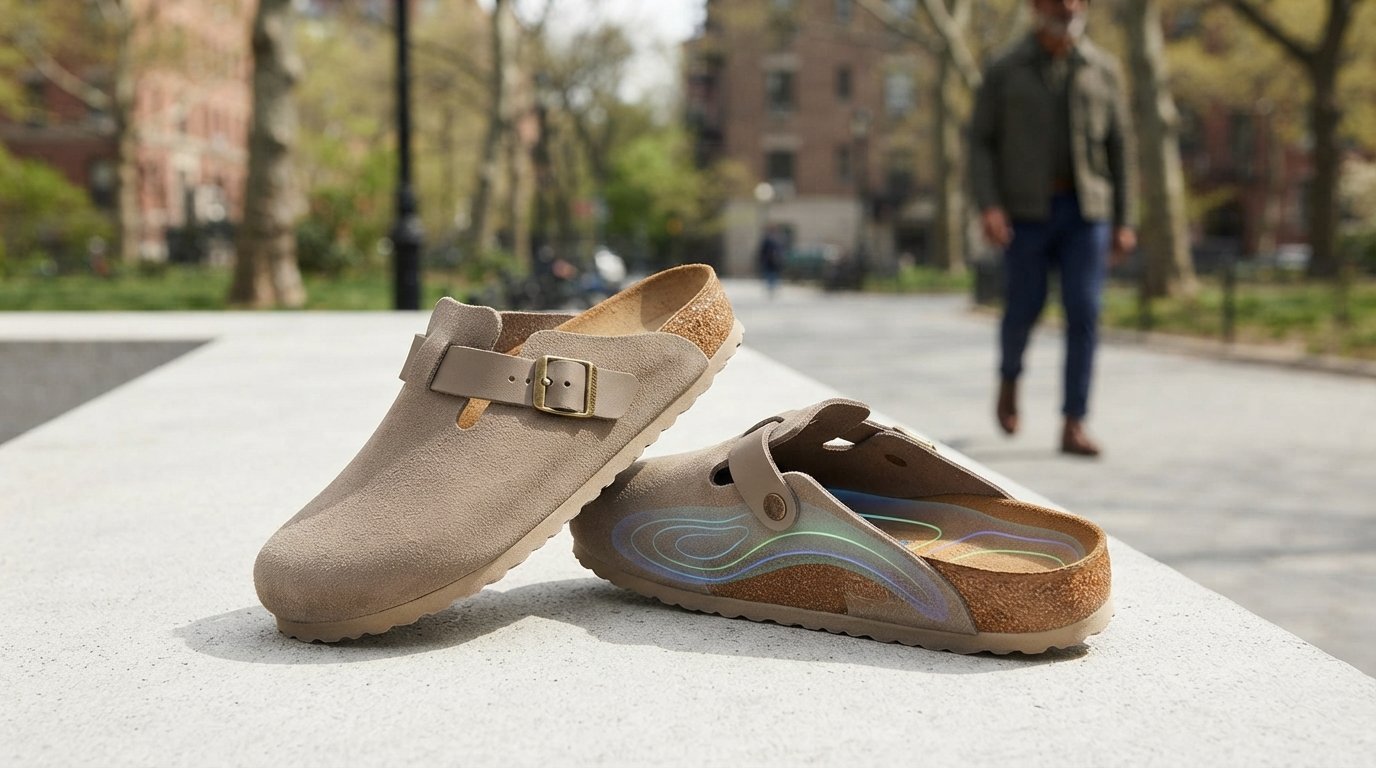
Unlike standard flat slip-on shoes that force your plantar muscles to tense with every step, authentic Birkenstock clogs rely on an orthopedically designed foundation. Every contour serves an intentional biomechanical purpose. The deep heel cup cradles your calcaneus, holding the heel bone in its natural position and preserving your foot’s natural fat pad for organic shock absorption. Running along the sole’s length, the interior and exterior longitudinal arches stabilize the midfoot, while the transverse arch across the ball of the foot supports the metatarsal bones.
At the front of the platform, an ergonomic raised toe bar encourages a natural gripping reflex, actively stimulating circulation and preventing your toes from clawing. Grounded in decades of Birkenstock footbed history, this platform replaces artificial cushioning with sustainable materials. Natural cork, latex milk, and dense jute fibers work together as a dynamic shock absorber that relieves strain on your knees and lower spine.
The Four Layers of Support
The resilience of the classic footbed relies on four synchronized layers:
- Suede Top Liner: A breathable, moisture-absorbing upper surface that feels soft against bare skin and maintains a balanced climate.
- Upper Jute Layer: A natural vegetable-fiber mesh that wicks away residual moisture.
- Cork and Latex Core: The shoe’s structural heart, blending insulating cork granules with elastic latex to create a supportive platform that gradually contours to your footprint.
- Lower Jute Layer: A dense, stabilized bottom mesh that reinforces the cork core and enhances longitudinal flexibility across the sole.
Original vs. Soft Footbed: Which is Right for You?
Your choice depends on your sensitivity and need for immediate pressure relief. The Original Footbed offers unyielding, firm support. It takes several weeks of gradual wear to compress and contour to your arches, but it delivers unmatched structural stability for tired joints.
If you have sensitive soles, low pain thresholds, or acute heel spurs, the Soft Footbed provides an ideal alternative. It features an integrated anatomical foam cushion inserted beneath the suede lining, packed with millions of microscopic air pockets for immediate step-in relief. You can quickly tell the two styles apart by checking the footbed stamp: original classic footbeds are stamped in black lettering, while soft footbeds show a distinctive blue print.
Choosing Your Style: Leather, Suede, and Professional Options
Choosing the right Birkenstock clogs means matching upper materials and sole construction to your daily routine. Suede remains a perennial favorite for casual wear, delivering an exceptionally soft, flexible feel that requires virtually no break-in period across the bridge of your foot. For elevated durability, premium leathers offer stronger structural retention. Oiled leather features an untreated, waxed finish (typically 2.8 to 3.2 millimeters thick) that develops a rich, individual patina while resisting outdoor abrasions. In contrast, smooth-finished leathers offer a clean, polished aesthetic suited to office environments.
Color choices also influence versatility. Rich, dark brown Birkenstocks remain a timeless staple for 2026, pairing seamlessly with casual denim, tailored trousers, or relaxed knitwear while hiding everyday scuffs. If you’re also exploring other popular suede slip-on styles for casual wear, our detailed breakdown of the UGG Tasman vs Tazz explains how sole height and fleece lining density affect walking stability and all-day comfort.
Material Durability and Maintenance
Each upper material requires simple, intentional care to preserve its resilience. Thick oiled leather excels in longevity and moisture resistance and needs only occasional leather conditioner to stay supple. Suede requires gentle maintenance with a specialized brass or rubber nap brush to lift surface dust and restore texture. If you prefer animal-free footwear, high-grade synthetic microfibers provide a tear-resistant, breathable alternative that wraps securely around the foot without compromising internal support.
The Professional Choice: Clogs for Healthcare and Hospitality
Standard footwear often fails in high-demand work settings where long standing shifts meet slick, hard surfaces. That is why nurses, surgeons, and culinary professionals rely heavily on certified occupational styles like the Tokio Pro and Super-Birki. These models feature certified slip-resistant polyurethane or TPU outsoles tested against oil, water, and grease, and they comply with EN ISO 20347:2022 standards.
Closed-toe leather and polyurethane shells protect against accidental hot liquid spills and falling kitchen tools, while the wide toe box aligns with Harvard Health’s footwear fitting guidelines by allowing toes to splay naturally under body weight. If standing on hard hospital tile or restaurant floors leaves you with heel irritation, explore our curated resource on the Best Shoes for Foot Pain to learn how rigid platforms reduce plantar pressure. You can also explore Feet for Life’s authorized wellness collection to find professional footwear crafted for demanding careers.
Orthopedic Benefits: Why Clogs are a Game-Changer for Foot Health
While fashion lovers celebrate their timeless aesthetic, orthopedic specialists value Birkenstock clogs for their therapeutic impact on mechanical foot disorders. Plantar fasciitis, one of the most common causes of persistent heel pain, occurs when the thick band of tissue along the bottom of your foot suffers repetitive micro-tears because of insufficient arch support. As the Mayo Clinic explains about plantar fasciitis and arch support, maintaining firm medial arch contact relieves structural tension on the aponeurosis during weight-bearing steps.
For individuals dealing with overpronation, the rigid cork sole acts as a subtle physical guide. Instead of letting your ankles roll inward, the elevated interior rim keeps your foot moving through a neutral gait cycle. Pressure spreads evenly across the entire plantar surface instead of concentrating under the metatarsal heads or the calcaneal spur. Runners and active walkers also benefit from wearing them after high-impact training, giving compressed foot muscles a stable platform to decompress.
Alignment Beyond the Feet
Your feet are the physical base of your entire skeletal system. When an arch collapses inward, it triggers internal rotation of the tibia, which torques the knee joint, tilts the pelvis, and strains the lumbar spine. This connected biomechanical chain means stabilizing your feet directly relieves chronic lower back aches. To learn more about postural health, read our Footwear 101 guide to see how strong structural foundations protect your joints.
Birkenstock Clogs vs. Traditional Orthopedic Shoes
Footwear design often splits between two philosophies: dynamic cushioning and structural rigidity. Brands like Hoka rely on thick, maximalist EVA foam outsoles to absorb vertical impact forces during repetitive forward motion. In contrast, Birkenstock clogs use rigid cork-latex contours that resist collapse, training your intrinsic foot muscles to stabilize themselves.
Choose an open-back clog when you are standing in place, working around the home, or managing Achilles bursitis, where rigid heel counters on conventional walking shoes cause painful rubbing. Save athletic sneakers for sustained aerobic walking, and choose rigid cork clogs to maintain structural support throughout your casual day.
The Perfect Fit: A Guide to Birkenstock Sizing and Widths
Achieving Birkenstock’s legendary comfort depends on choosing the right size for your foot. Because the cork platform is contoured, not flat, your foot must sit within its protective borders. Follow this systematic process to secure an ideal fit:
- Step 1: Measure in Millimeters. Birkenstock’s European sizing correlates precisely to foot length in millimeters. Trace your foot on paper in the evening, measure from heel to the longest toe, and use the millimeter conversion chart.
- Step 2: Decode the Width Footprint. Birkenstock stamps each footbed with a footprint icon. An outline (hollow) icon denotes a Regular fit, designed for medium to wide feet (women’s C to D, men’s D to EE). A solid (filled-in) icon indicates a Narrow fit, best suited for slim to average widths (women’s A to B, men’s B to C).
- Step 3: Anchor the Calcaneus First. Place your bare or socked foot completely back into the deep heel cup before adjusting the instep buckle. Fasten the strap loosely enough that a finger easily slides underneath, allowing natural movement while walking.
- Step 4: Verify Perimeter Spacing. Leave about 5 millimeters of space behind the heel and 10 millimeters (about 0.4 inches) in front of the toes. This buffer prevents your toes from colliding with the firm cork lip during toe-off.
Common Sizing Mistakes to Avoid
Many wearers select clogs that are too short, causing their toes to ride up onto the raised outer rim. Over time, that friction damages the cork and bruises the nail bed. Another common error is assuming you need a Regular width when you actually need Narrow; Birkenstock’s Narrow corresponds closely to a standard American medium. Keep in mind that as the cork bed flexes and curls with your natural gait, the shoe naturally shortens by a fraction of a millimeter.
The Break-In Period: What to Expect
Fresh cork out of the box feels notably firm underfoot. The natural cork-latex composite relies on body heat, sweat, and cumulative downward pressure to mold precisely to your plantar surface over 7 to 14 days. Ease into your pair by wearing them indoors with socks for one to two hours daily during the first week. You can safely speed up this transition by gently flexing the sole with your hands before slipping them on. To start your journey toward balanced postural alignment, find your ideal pair of Birkenstock clogs at Feet for Life and experience true biomechanical support.
Investing in Longevity: Why Feet for Life is Your Birkenstock Partner
Selecting authentic wellness footwear is only the first step toward lasting mobility; having access to dedicated fitting expertise ensures those choices deliver results. As an authorized Birkenstock retailer, Feet for Life provides nationwide guidance backed by over four decades of footwear expertise. Our curated inventory prioritizes proven silhouettes crafted from thick, premium oiled leathers and resilient suedes, ensuring your footwear maintains structural integrity through seasons of daily use.
Achieving total joint relief requires a balanced, 24-hour strategy. While Birkenstock clogs provide a rigid, supportive platform for casual wear and indoor recovery, high-impact running or fitness walking calls for active motion control. By rotating your clogs alongside dynamic running and walking shoes from trusted brands like Brooks and Hoka, you create a comprehensive foundation for daily foot health. For athletic trainers, work boots, or dress shoes without built-in arch support, over-the-counter Powerstep insoles keep your arches stable wherever your schedule takes you.
Sustainability and Repairability
Birkenstock footwear stands apart from disposable fast fashion because it is designed to be renewed, not discarded. Certified repair cobblers can professionally replace the lightweight EVA outsoles, heel pads, and footbeds, turning your clogs into a long-term investment that reduces landfill waste. To protect the core structure, regularly inspect the exposed cork edge. When the perimeter loses its glossy protective sheen and appears chalky, apply a thin coat of cork sealant to block moisture intrusion and prevent brittleness.
Your Next Step Toward Foot Wellness
Chronic plantar pain and daily fatigue don’t have to dictate your daily lifestyle. Switching from unsupportive slip-ons to biomechanically sound footwear helps your body regain its natural balance, step by step. Take control of your daily comfort and shop our curated Birkenstock collection to discover how genuine alignment revitalizes every stride.
Step Into Lasting Alignment and Daily Ease
Finding lasting relief from foot strain starts with respecting your skeletal mechanics. Authentic Birkenstock clogs give your arches firm structural support, reduce tension on the plantar fascia, and offer durable materials built for your daily routine. From slip-resistant occupational pairs to supple suede favorites, choosing the right width and respecting the cork break-in window can transform how your body feels after hours on your feet.
Your feet carry you through every milestone and busy workday; they deserve intentional support. As an authorized premium footwear retailer offering national shipping on all comfort styles, Feet for Life delivers expert support for foot pain relief so you never have to compromise your physical well-being. Take a proactive step toward whole-body comfort today. Browse our professional Birkenstock clog collection and discover how natural orthopedic alignment energizes every stride.
Frequently Asked Questions
How long do Birkenstock clogs typically last with daily wear?
Birkenstock clogs typically last several years with daily wear, provided you maintain them properly. The natural cork footbed and thick leather uppers are exceptionally durable. By applying cork sealant whenever the exposed edges look dry and having a cobbler resole the EVA outsoles before the tread completely wears smooth, many wearers keep their favorite pairs in active daily rotation for five to ten years.
Can I wear Birkenstock clogs if I have high arches?
Yes, they are an excellent choice for individuals with high arches. The anatomical footbed features pronounced interior longitudinal and transverse arch supports designed to bridge the hollow space beneath high-arched feet. This targeted elevation fills the void flat shoes leave unsupported, distributes body weight evenly across the entire sole, and reduces excessive pressure on the metatarsal bones and heel pad.
Are Birkenstock clogs suitable for people with plantar fasciitis?
They are widely recommended for plantar fasciitis because of their rigid base. The deep heel cup cradles the calcaneus to prevent fat pad displacement, while the firm medial arch stops the plantar fascia band from overstretching during heel strike. Many wearers experiencing heel pain find that switching from soft, collapsible slippers to structured cork clogs provides immediate daily relief.
What is the difference between oiled leather and suede Birkenstock clogs?
The main differences are texture, thickness, and daily resilience. Oiled leather features an untreated, waxed surface around 3 millimeters thick that resists light moisture, scratches, and harsh weather while developing an organic patina. Suede is a supple split leather with a velvety finish, offering immediate flexibility and a relaxed aesthetic, though it requires gentle brushing to prevent stains and moisture marks.
Should I buy a size smaller or larger in Birkenstock clogs?
You should typically purchase your true European size rather than sizing up or down. Birkenstock designs footbeds to include built-in space buffers: roughly 5 millimeters behind the heel and 10 millimeters in front of the toes. Sizing down forces your toes against the firm protective perimeter rim, while sizing up shifts the arch contours out of position along your foot.
How do I clean the footbed of my Birkenstock clogs?
Clean the suede footbed liner using a mixture of mild water and gentle soap or specialized cleaner. Lightly scrub the liner using a damp brush or cloth in small circular motions to lift perspiration and debris. Avoid soaking the cork core completely. Once clean, let the shoes air-dry naturally at room temperature, away from direct sunlight and artificial heat sources.
Are Birkenstock clogs professional enough for office wear?
Modern workplace dress codes increasingly welcome tailored casual styles, especially in darker oiled leathers or smooth finishes. Pair dark brown or black leather clogs with chinos, tailored trousers, or dark denim for an elevated, polished look that delivers orthopedic comfort through long seated or standing office days. Their structured silhouette blends everyday style with restorative support.
Can I use my own custom orthotics inside Birkenstock clogs?
In classic cork models of Birkenstock clogs, the contoured footbed is permanently glued to the shoe base, so they’re incompatible with separate inserts. Layering an orthotic on top changes the shoe’s internal volume and displaces the built-in contours. If you rely on external orthotics or Powerstep insoles, choose occupational models with removable footbeds or reserve those supportive inserts for your walking shoes.

Article by
Sandra Parker
Sandra Parker is part of the family ownership team behind Feet for Life, a family-owned comfort footwear retailer serving customers in Visalia and Bakersfield, as well as nationwide online.
With more than 20 years of involvement in the family footwear business, Sandra brings extensive experience in retail marketing, customer education, footwear trends, and product selection. She is passionate about helping customers find comfortable, stylish, supportive footwear for everyday life.
Through Feet for Life, Sandra shares practical footwear advice, seasonal shopping trends, and insights into trusted footwear brands.


